
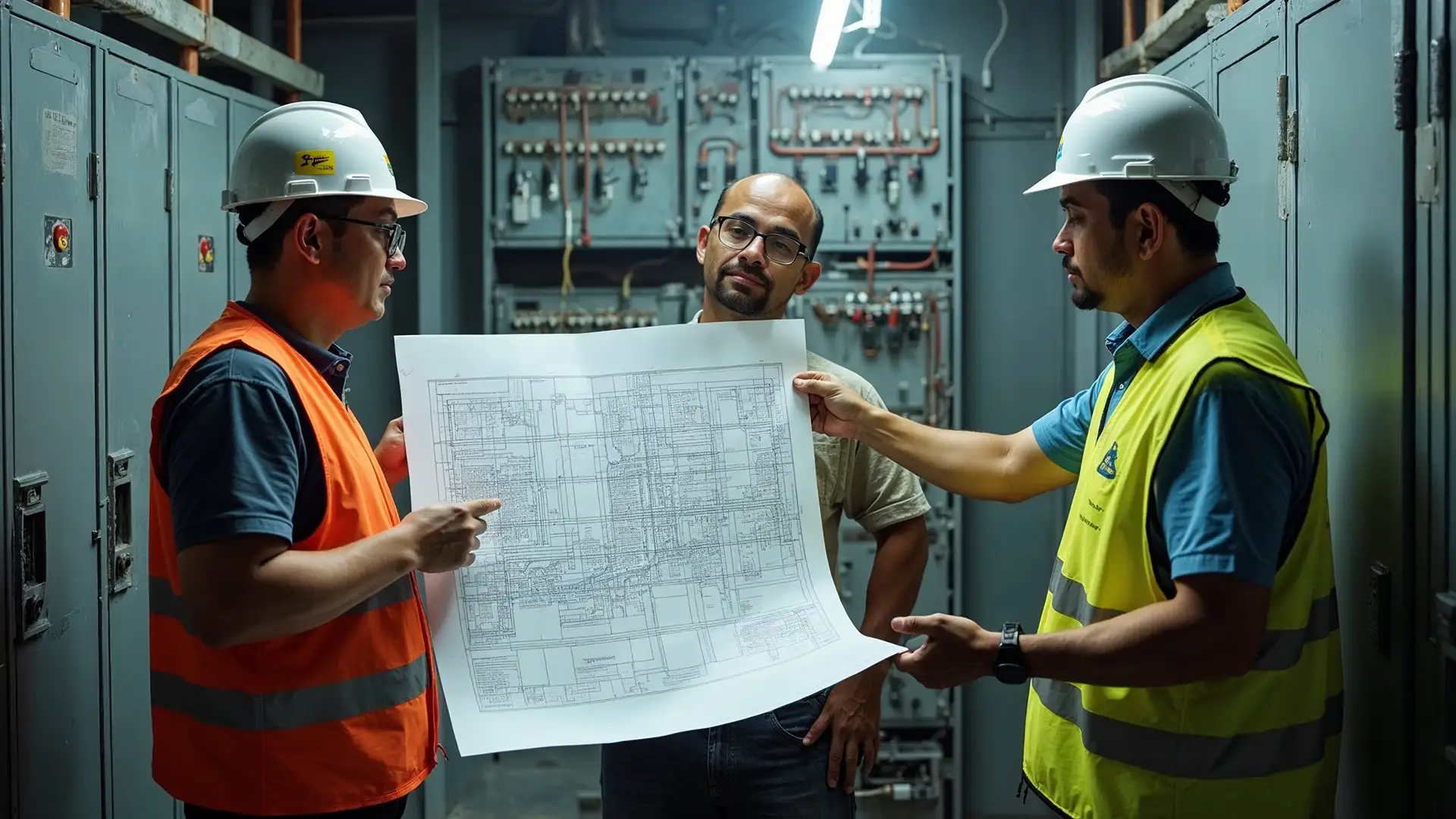
Electrical designs can be compliant, coordinated on paper, and fully approved, yet still struggle during installation, testing, and handover. This is a common reality across commercial and industrial projects in Malaysia.
At Pro E, we see this pattern repeatedly. The issue is not technical capability or standards. It is the gap between design intent and how a system actually behaves on site.
This article explains why that gap exists and how Pro E’s execution framework closes it.
Why does a compliant electrical design still fail during construction?
Because compliance does not guarantee buildability.
Design reviews confirm that loads, protection, and standards are met. They rarely test whether the system can be installed, accessed, tested, and maintained under real site conditions.
At Pro E, we find failures typically originate from:
- routing paths that look feasible on drawings but conflict with actual structural and architectural conditions
- equipment layouts that meet minimum clearance requirements but restrict testing and maintenance access
- installation sequences that are not planned against the realities of multi-trade construction
In other words, the design may be technically correct, but the system is not yet constructible.
This is where rework, coordination clashes, and late-stage changes begin.
What site conditions in Malaysia make electrical systems harder to deliver?
Malaysia’s project environment introduces constraints that are often underestimated during design.
Tighter floor plates and space optimisation
Electrical rooms, risers, and service corridors are frequently reduced to maximise usable area. While commercially attractive, this increases congestion, limits routing flexibility, and restricts safe working space during installation and testing.
Thermal stress and ventilation challenges
High ambient temperatures combined with dense equipment layouts place significant heat loads on switchboards, cabling, and distribution systems. Ventilation that appears adequate on drawings may not perform once equipment is energised.
Changing tenant and equipment loads
Automation, data systems, and specialised machinery regularly alter load profiles after initial design. Systems that lack realistic expansion planning struggle to adapt without modification.
Fast-track project schedules
Compressed timelines leave little margin for late coordination. When sequencing is not planned early, electrical installation becomes reactive rather than structured, increasing the likelihood of rework during commissioning.
None of these conditions violate standards. They expose how electrical systems behave in real Malaysian project environments.
What typically goes wrong during testing and commissioning?
Testing and commissioning is where assumptions meet physical reality.
Across projects, Pro E most commonly encounters:
- restricted access to panels caused by congested layouts
- overheating from insufficient airflow around equipment
- earthing and bonding conflicts discovered only after installation
- late routing changes that require re-termination and re-testing
- incomplete as-built documentation that delays inspection and handover
At this stage, corrections are costly. They disrupt other trades, extend inspection timelines, and delay operational readiness.
Most of these issues originate from early planning decisions, not from installation workmanship.
How does Pro E prevent these failures on real projects?
At Pro E, we apply a structured Execution Framework to ensure that systems are not only compliant, but also constructible, testable, and durable.
Our framework is built on four principles:
1. Constructability before installation
We review routing, equipment placement, access clearances, and working space against actual site constraints. This reduces clashes and prevents late-stage design changes.
2. Installation sequencing
We plan how systems will be installed, energised, and tested in relation to structural completion and other trades. This avoids reactive installation and protects downstream testing.
3. Pre-commissioning verification
Before formal testing, we verify access, airflow, earthing continuity, and equipment clearances. This prevents failures that would otherwise appear during T&C.
4. Site-aligned documentation
As-built records reflect what was actually installed, not just what was designed. This supports inspections, handover, and future maintenance without uncertainty.
In practice, this approach reduces rework, shortens testing cycles, and improves handover reliability. It transforms electrical works from a risk point into a predictable delivery sequence.
What this means for projects in Malaysia in 2026
Passing a design review is no longer enough.
As Malaysian projects become more compact, more equipment-dense, and more time-constrained, the gap between design and execution continues to widen. Electrical success now depends on understanding system behaviour on site, not just technical compliance.
At Pro E, we approach every project with a simple principle:
We explain how the system behaves, then we deliver it with predictable outcomes.
This mindset:
- reduces rework
- prevents commissioning delays
- improves safety and maintainability
- ensures long-term system reliability
Electrical systems that last are not only well designed.
They are planned, coordinated, and executed based on how they will actually be built and operated.
Why this approach matters
When engineering decisions are evaluated only on drawings, risks stay hidden until late in the project. By focusing on system behaviour, constructability, and execution discipline, Pro E helps project teams move from compliance to confidence.
This is how electrical systems stop being a source of uncertainty and start becoming a foundation for dependable operations.
 The Golden Bull Award for Outstanding SME